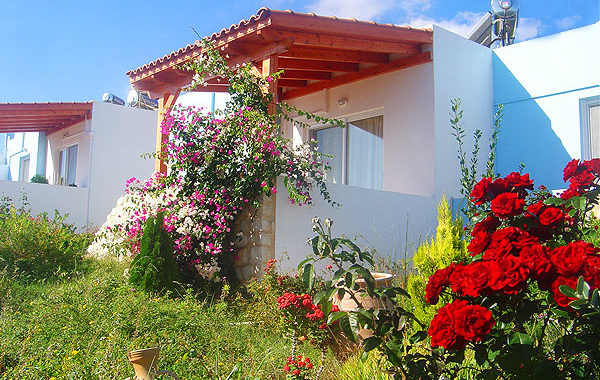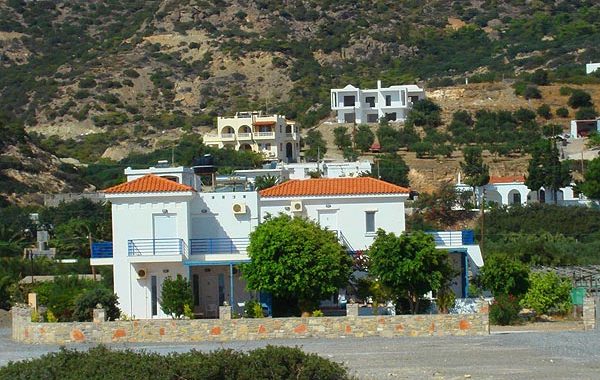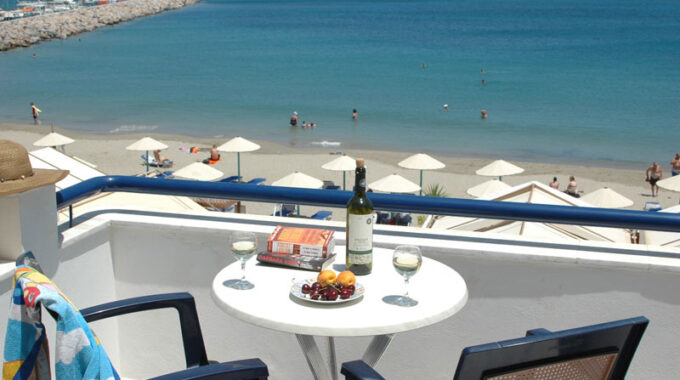
Thalassa apartments offer charming self-catering accommodation for your holidays in Palekastro, Sitia and Eastern Crete.…
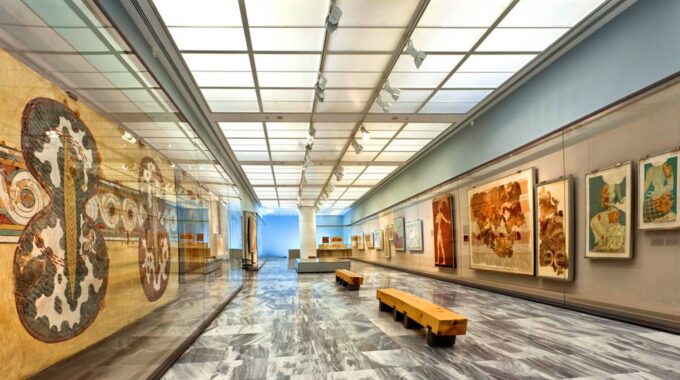
Heraklion Archaeological Museum
Situated in the center of Heraklion, the Heraklion Archaeological Museum stands among the most important cultural institutions in Europe and is the principal museum for the study of Cretan prehistory. Its collections, drawn from sites across the island, document continuous human presence from the Neolithic period to Roman rule, with particular emphasis on the Bronze Age civilization commonly known as the Minoan civilization.
Historical Development
The museum’s origins lie in the late nineteenth century, when local scholars and administrators began gathering antiquities unearthed during early excavations on Cretan soil. The first organized display spaces were established between 1904 and 1908 near the site of the Venetian Monastery of Saint Francis.
The current museum building was designed by Greek modernist architect Patroklos Karantinos and constructed between 1935 and 1958. Its architectural language combines functional modernism with references to Minoan decorative forms and colors. During the Second World War, the collection was carefully concealed to prevent damage or looting.
A comprehensive renovation completed in 2014 transformed the museum into a contemporary exhibition space, improving conservation conditions while enhancing visitor interpretation and accessibility.
Scope and Scholarly Importance
The museum preserves artifacts spanning roughly seven millennia, making it the most authoritative center for the study of ancient Crete. Its holdings from major sites such as Knossos, Phaistos, and Malia Palace provide essential evidence for reconstructing social structure, religious practices, artistic expression, and economic networks in the Bronze Age Aegean.
Exhibition Overview
The permanent exhibition is arranged chronologically and thematically, guiding visitors through the evolution of Cretan society.
Neolithic and Early Bronze Age
The earliest galleries present stone tools, pottery, and figurines documenting the emergence of settled life, agriculture, and craft specialization on the island.
Formation of Palatial Society
Displays trace the transition toward complex social organization, culminating in the rise of palace centers that functioned as administrative, economic, and religious hubs.
The Minoan World
The core of the museum is devoted to Minoan culture (c. 2000–1450 BCE). Objects recovered from palaces, villas, sanctuaries, and tombs illuminate:
- administrative systems and hierarchy
- ritual practice and symbolic imagery
- maritime trade and intercultural exchange
- domestic life and ceremonial activity
Ceramics, carved stone vessels, seals, jewelry, and metalwork illustrate both everyday practices and elite craftsmanship.
Masterpieces of Minoan Art
Among the most significant works are:
- The Snake Goddess figurines (c. 1650 BCE), associated with household ritual and fertility symbolism
- A stone bull’s-head rhyton, used in ceremonial libations
- The Bull-Leaping fresco, depicting a ritual athletic performance
- The Prince of the Lilies fresco from Knossos
- The enigmatic Phaistos Disc, bearing spiral symbols in an undeciphered script
- The Hagia Triada Sarcophagus, illustrating funerary rites
- The gold Bee Pendant from Malia, a masterpiece of miniature metalwork
- Polychrome Kamares Ware pottery, renowned for its technical precision and decorative complexity
Together, these objects testify to the sophistication, symbolism, and technical expertise of Minoan artisans.
Frescoes and Aesthetic Ideals
Reconstructed wall paintings from palatial complexes present dynamic scenes of marine life, flora, ceremonial processions, and athletic activities. Their fluid lines and vibrant color palette reveal a visual language deeply connected to nature and ritual performance.
Writing, Administration, and Exchange
Clay tablets inscribed with Linear A and Linear B scripts attest to the bureaucratic organization of palace economies. Evidence of maritime exchange demonstrates Crete’s connections with Egypt, the Levant, and the wider Aegean.
From Greek City-States to Roman Crete
Upper galleries trace the island’s transformation after the collapse of the palatial system. Sculptures, inscriptions, coins, and funerary offerings illustrate the development of city-states and Crete’s incorporation into the Roman Empire. During Roman administration, Gortyn emerged as the provincial capital, reflecting renewed prosperity and integration into Mediterranean networks.
Sculpture Collection
An independent sculpture gallery presents works dating from the seventh century BCE to the third century CE, including Archaic statues, Classical-style forms, and Roman imperial portraits that reflect evolving artistic influences and political identity.
Cultural Role Today
Today the museum functions not only as an exhibition space but also as a research center and educational institution. Temporary exhibitions, conservation programs, and academic collaborations continue to expand understanding of the ancient Mediterranean world.
A Central Archive of Aegean Prehistory
The Heraklion Archaeological Museum offers an essential framework for interpreting Europe’s earliest complex society. Through its unparalleled Minoan collections and comprehensive historical sequence, it provides both scholars and visitors with a coherent narrative of Crete’s enduring role in the ancient Mediterranean.
Additional Info
Museum type: Archaeological Museum, one of Greece’s most important museums in Greece
Address: Xanthoudidou St. 1, Heraklion 712 02, Crete, Greece
Opening Hours: Summer season (approx. April – October): Monday: 08:00 – 20:00 Tuesday: 10:00 – 20:00 Wednesday – Sunday: 08:00 – 20:00 Winter season (approx. November – March): Monday: 08:30 – 15:30 Tuesday: 10:00 – 17:00 Wednesday – Sunday: 08:30 – 15:30 Hours may vary on holidays.
Website: heraklionmuseum.gr
Contact: Phone: +30 2810 279000, Email: info@heraklionmuseum.gr
Official visitor details for the Heraklion Archaeological Museum, one of Greece’s most important museums.
Contact Information
Address: Xanthoudidou St. 1, Heraklion 712 02, Crete, Greece
Phone: +30 2810 279000
Email: info@heraklionmuseum.gr
Website: heraklionmuseum.gr
Summer season (approx. April – October):
Monday: 08:00 – 20:00
Tuesday: 10:00 – 20:00
Wednesday – Sunday: 08:00 – 20:00
Winter season (approx. November – March):
Monday: 08:30 – 15:30
Tuesday: 10:00 – 17:00
Wednesday – Sunday: 08:30 – 15:30
Hours may vary on holidays.
January 1
March 25
May 1
Easter Sunday
December 25 & 26
General admission: €12 (summer) / €6 (winter)
Reduced ticket: €6 (summer) / €3 (winter)
Free admission: EU citizens under 25 & certain categories
Combined ticket: Available with nearby archaeological sites (e.g., Knossos)
Related Articles