
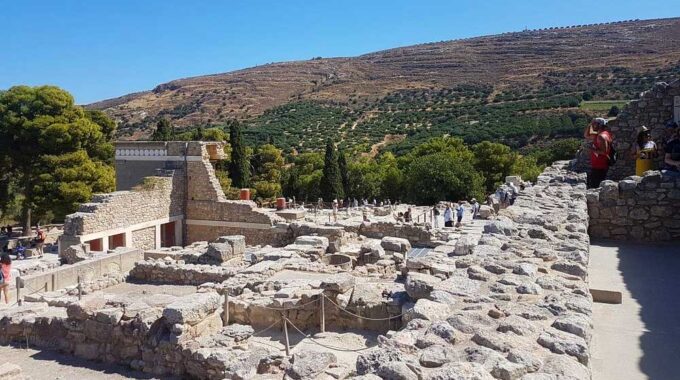
Perched on the Kephala hill near Heraklion, Crete, Knossos isn't just an archaeological site; it’s…
Knossos: Understanding Cretan history
Expanding on the initial overview, the archaeological site of Knossos is a complex palatial city that served as the nerve center of the Minoan world. To understand Knossos, one must look at it as a living entity that evolved over thousands of years—from a Neolithic village to a Bronze Age superpower, and finally, a reconstructed museum of the early 20th century.
1. The Architectural Anatomy of the Palace
The palace we see today is primarily the “New Palace” (Neopalatial), built around 1700 BCE after a massive earthquake destroyed the previous structure. It covered roughly 20,000 square meters and featured a polythyra (pier-and-door partition) system that allowed for flexible space management.
Key Sections of the Site
The Central Court: The heart of the complex (50 X 25 meters). It was the site of the famous Bull-Leaping rituals. Its orientation (North-South) was designed to align with the sacred mountain of Juktas.
The West Wing (Religious & Administrative): Contains the Throne Room, featuring the original gypsum throne and frescoes of griffins. This wing also houses the West Magazines—18 long rooms that could hold up to 240,000 liters of olive oil and grain in giant clay jars (pithoi).
The East Wing (Domestic Quarters): Built into the side of the hill, this area includes the Grand Staircase (a masterpiece of light and ventilation) and the Queen’s Megaron, famous for the Dolphin Fresco.
The Royal Road: Often called the oldest paved road in Europe, it led from the city to the Theatral Area, a stepped space used for public gatherings or ceremonies.
2. Chronological Timeline of Knossos
The site’s history is traditionally divided into periods based on the construction and destruction of the palaces.
Period-Dates (approx.)-Significance
Prepalatial | 3000 – 1900 BCE | Transition from Neolithic village to organized urban center.
Protopalatial | 1900 – 1700 BCE | Construction of the First Palace; emergence of Linear A script.
Neopalatial | 1700 – 1450 BCE | The Golden Age. Most “Minoan” art and architecture date from here.
Postpalatial | 1450 – 1100 BCE | Mycenaean takeover. Linear B script replaces Linear A.
Post-Bronze Age | 1100 BCE – 1900 CE | Site remains inhabited as a city-state; eventually buried and forgotten.
3. The Modern Era: Excavation and Reconstruction
The resurrection of Knossos is almost as famous as the site itself. While Minos Kalokairinos first identified the site in 1878, it was Sir Arthur Evans who bought the land and began full-scale excavations in 1900.
The Evans Controversy
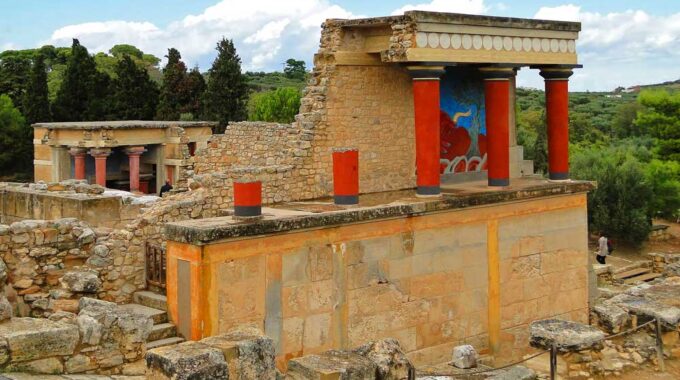
Evans made a revolutionary choice: instead of just digging up stones, he decided to reconstruct the palace using steel and concrete.
Why he did it: To prevent the soft gypsum and limestone from eroding and to help the public visualize the Labyrinth.
Modern Criticism: Archaeologists today point out that his reconstructions were often based on educated guesses. For example, the Prince of the Lilies fresco is actually a composite of three different people found in separate areas.
The Outcome: Whether accurate or not, Evans’ vision created the iconic red-columned aesthetic that defines Minoan culture in the global imagination.
4. Knossos in the 21st Century
Archaeology at Knossos didn’t stop with Evans. Recent decades have focused on the Knossos Urban Landscape Project, which uses satellite imagery and surface surveys to map the city outside the palace walls.
Significant Recent Updates
UNESCO World Heritage Status (2025): In a landmark decision in July 2025, UNESCO officially added Knossos—along with five other Minoan palatial centers (Phaistos, Malia, Zakros, Zominthos, and Kydonia)—to the World Heritage List. This recognizes them collectively as the Minoan Palatial Centres of Crete.
Linear B Insights: Ongoing analysis of the 3,000+ tablets found at Knossos has refined our understanding of the Mycenaean period, revealing a highly organized command economy that tracked everything from spice rations to bronze spearheads.
Note on Visiting: Most of the original frescoes, including the Snake Goddess figurines and the Phaistos Disc, are kept in the Heraklion Archaeological Museum to protect them from the elements; the ones you see on-site are high-quality replicas.
The site’s history is traditionally divided into periods based on the construction and destruction of the palaces
Related Articles


This Post Has 0 Comments