
Expanding on the initial overview, the archaeological site of Knossos is a complex palatial city…
Knossos: The Heart of the First European Civilization
Perched on the Kephala hill near Heraklion, Crete, Knossos isn’t just an archaeological site; it’s a portal to a world that feels both impossibly ancient and surprisingly modern. As the ceremonial and political center of the Minoan civilization, it is often cited as the oldest city in Europe.
Whether you’re there for the history or the myths of Minotaurs and thread-wielding princesses, Knossos remains one of the most provocative sites in the Mediterranean.
The Minoan Golden Age (c. 1900 – 1450 BCE)
The Minoans didn’t call themselves Minoans (that was a 19th-century branding choice by archaeologists), but they were the undisputed masters of the Aegean. Their power wasn’t built on massive walls—Knossos is famously unfortified—but on a Thalassocracy (sea power).
Life in the Labyrinth
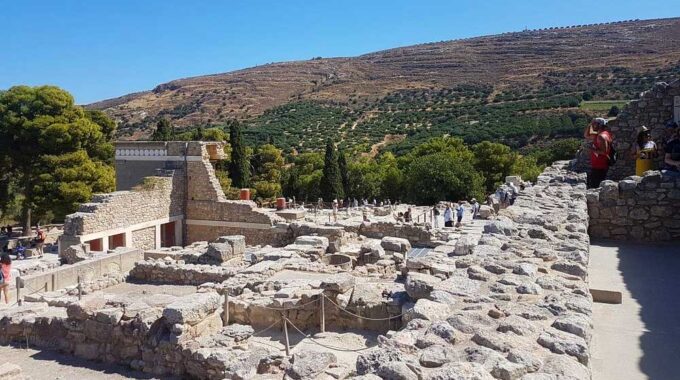
The Palace was more than a royal residence; it was a sprawling complex of over 1,300 rooms that functioned as a religious center, a factory, and a giant warehouse for olive oil and grain.
Architecture: The Minoans were engineering pioneers, utilizing light wells for natural illumination and sophisticated drainage systems that wouldn’t be seen again for centuries.
Art and Culture: Their frescoes depict a society obsessed with nature and sport. The most famous, the Bull-Leaping Fresco, suggests a ritualistic (and incredibly dangerous) dance between humans and beasts.
The Myth: The complex’s confusing, multi-storied layout likely inspired the Greek legend of the Labyrinth, built by Daedalus to house the Minotaur.
The Fall
The decline of Knossos is a subject of much debate. While the massive volcanic eruption of Thera (Santorini) around 1600 BCE caused significant damage via tsunamis and ash, the palace survived for another century. It finally fell around 1450 BCE, likely due to a combination of internal social unrest and an invasion by the Mycenaeans from mainland Greece.
The Era of Discovery: Sir Arthur Evans (1900 onwards)
For millennia, Knossos was a ghost story—a myth buried under layers of earth. That changed in 1878 when a Cretan businessman, Minos Kalokairinos, discovered the first storage jars (pithoi). However, the modern history of Knossos truly begins in 1900 with the British archaeologist Sir Arthur Evans.
A Controversial Resurrection
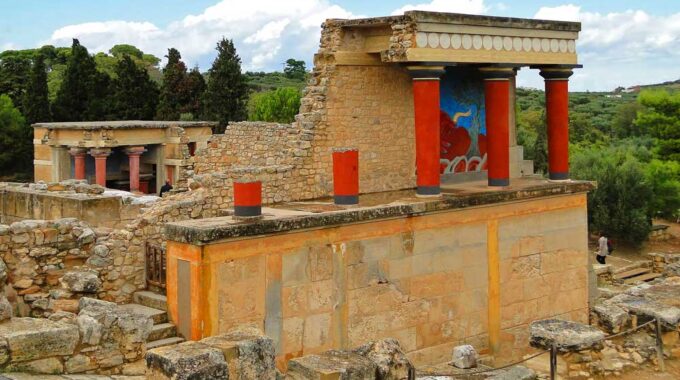
Evans didn’t just dig; he rebuilt. Using reinforced concrete, he reconstructed sections of the palace, repainted frescoes, and re-erected columns.
| Pros of Evans’ Work | Cons of Evans’ Work |
| Made the site accessible and readable to the public. | Used materials (concrete) that are now deteriorating and damaging the stone. |
| Preserved structures that might have collapsed after exposure. | His reconstructions are often based on his own romanticized interpretations rather than hard evidence. |
| Brought international attention to Minoan culture. | Some frescoes were over-restored, blurring the line between ancient art and 1920s style. |
Despite the criticism, Evans’ work allowed us to see the Throne Room—thought to be the oldest throne room in Europe—and the iconic red-tapered columns that define the site’s aesthetic today.
Knossos Today: Science and Tourism
Related Articles


This Post Has 0 Comments