
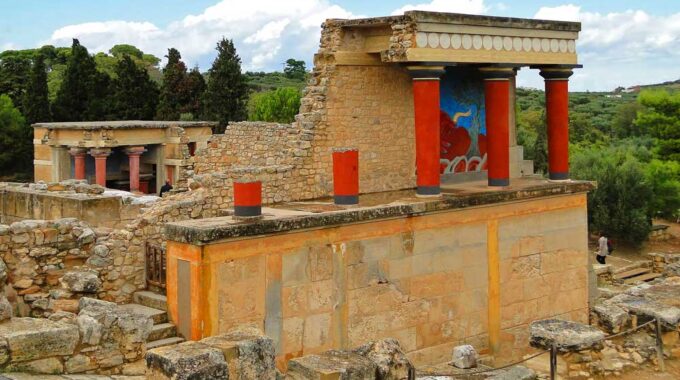
Expanding on the initial overview, the archaeological site of Knossos is a complex palatial city…
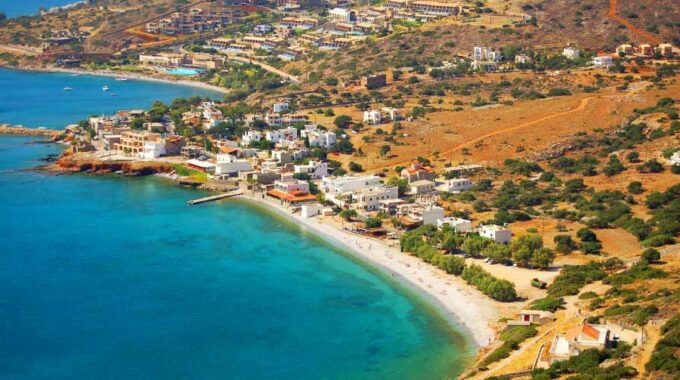
Plaka
To reach Plaka coastal village you can take the coastal road north of Agios Nikolaos towards Elounda and shortly after Elounda (5 km) you will reach the small settlement of Plaka.
The best time to visit Plaka and Elounda is spring (March to June) and autumn (middle September to November), when the temperatures are more pleasant and the villages and beaches are less crowded. In the summer, and especially in the high season, it is more crowded because it is a well-known place among visitors, from where boats reach the island of Spinalonga in just 10 minutes, which operated as a leper colony from 1903 to 1957.
The existence of Plaka is strongly linked to Spinalonga, as the first supplies, as well as the patients themselves, were transported from Plaka to Spinalonga. Thus, the place developed, offering its thankless services to the living “dead” of the island. Besides, this picturesqueness, as well as the history of Spinalonga, made Plaka the ideal place to film the amazing MEGA TV series “The Island”, a milestone in the history of Greek Television (2010).
Enjoy beautiful views of the coast :
Once all these coastal settlements were small fishing villages, which have now developed into popular tourist destinations while retaining their authentic character in some places. Their rich history is intertwined with stories and maritime adventures, offering visitors a fascinating glimpse into Crete’s past. Today it is evolving into a cosmopolitan resort with remarkable tourist units, beautiful shops and picturesque fish taverns.
Of course, there are also many taverns and cafes around Plaka and near the beach where one can enjoy food and coffee with a view of the historic island of Spinalonga. The route from Agios Nikolaos to Plaka is impressive as the entire Mirabello Bay opens up to the east, you will enjoy views of the city of Agios Nikolaos and also the entire area of Elounda.
The beach is not long since its length does not exceed 200m and extends from the south of the settlement to quite far to the north where there is a parking lot where you can leave your vehicle. The beach is organized with umbrellas and sun loungers as you will also find changing rooms for showers
Plaka beach is not famous for its sandy beach. On the contrary, it has a pebble beach but with clear waters, offering a different seaside experience compared to other sandy beaches. The pebble beach of Plaka still offers a beautiful environment for swimming, relaxing and enjoying the picturesque view of the surrounding coastline. It is the right place if someone wants to avoid the crowds of the beaches of Agios Nikolaos and Elounda.
Continuing north of Plaka, you will reach the village of Vrouchas and see the old windmills. From there you can continue even further north to reach the lighthouse of Cape Aforesmenos, which is located at the northwesternmost point of the large Mirabello Bay.
An alternative route is to continue west of the settlement of Vrouchas to cross the amazing semi-mountainous Mirabello and the picturesque villages passing through small valleys and plateaus and reaching Neapoli or Milatos, from where you can continue on the National road to Heraklion.
Facilities-Additional Info
Distance: Heraklion 67km – Sitia 75km – Agios Nikolaos 11km – Ierapetra 44km
Police Station of Elounda 28410 41348 – Regional Clinic of Elounda (Schisma) 28410 41563 – Medical emergency calling center 166 – Tourist police: 171 – Hospital Agios Nikolaos 28410 66000
Beach type: Organized Beaches next to Elounda, Sand, Fine sand, small pebbles, ideal place for snorkeling, many people at high season
- Agia Paraskevi – Aγία Παρασκευή
- Epano Elounda – Eπάνω Ελούντα
- Epano Pine – Eπάνω Πιναί
- Kalydon – Καλυδών (Kolokitha island area)
- Kato Elounda – Κάτω Ελούντα
- Kato Pine – Κάτω Πιναί
- Mavrikiano – Μαυρικιανό
- Schisma – Σχίσμα
Plaka: Beaches,, villages, history and culture
Surrounded by the mountain of Oxa and Mount Karfi, Elounda is practically cut off from the surrounding settlements. Due to this geographical peculiarity, its inhabitants created their own distinct culture and character over the years. The mild climate, the enchanting environment, the contact with other islands and other coastal areas, had a beneficial effect on the formation of the idiosyncrasy of the inhabitants.
The rich history of Elounda is lost in the depths of time. During the Minoan years, the area of Poros was inhabited, and specifically the famous settlement of Ancient Olous, which flourished later during the classical and pre-Byzantine era. Ancient Olous, considered one of the 100 most important cities of Ancient Crete, is located on the narrow strip of land that connects the “Nisi” peninsula with the mainland. The French created the Kanali isthmus in the period 1897-1898, facilitating sea transport and at the same time transforming the peninsula into an island.
The prosperity of Olos continued during the Byzantine period, with two important monuments testifying to this, the Early Christian Basilica in the Poros area, and the Basilica of Kolokytha, built of white marble. In the text Synekdimos by the Byzantine author Hierocles, the region of Olos is mentioned under the name Alygkos.
The Venetians built the Alykes in the second half of the 13th century and at the same time rebuilt the fortress of Spinalonga. Also during the Venetian rule, many churches were built, some of which are the Holy Trinity, the church of the Ascension, the Virgin Mary and Agios Georgios. The local population was engaged in agriculture, fishing, the processing of whetstones and the production of salt. During the period 1928-1939, the Gulf of Elounda (Korfos) was used by the British Imperial Airways as a landing and refueling station for seaplanes on their way to India.
The popular British novelist Mary Stewart lived in Elounda for about a year, writing the book “The Moon-Spinners”, which was subsequently published in the British press with great success. Walt Disney then, in 1963, adapted the work of the same name into a film, and according to the wishes of the author Mary Stewart, the filming took place in Elounda. This film was instrumental in making the village of Elounda known to business circles both in Greece and abroad. With the publicity the area had received, in 1964 Elounda was registered as a tourist area by royal decree and from 1970 its image began to change radically. The mild climate, the exceptional natural beauty, the good services are just a few of the reasons why Elounda attracts thousands of visitors every year.
The beach before you reach Plaka is called Agia Marina, it is located in front of a large hotel (remember that no beach in Greece is private) and for this reason it is more organized than the one in Plaka. This beach also has coarse pebbles and a rocky-pebble bottom.
Spinalonga Island is a small island located in the bay of Elounda Lagoon, on the northern side of Mirabello Bay. It covers an area of almost 85 acres and its maximum altitude is 53 meters. The island’s history continues to inspire awe – it has been a Venetian fortress, a castle town, a refuge for revolutionaries, a place of exile for lepers, and a link of communication with Cairo during the Occupation.
The island was perfectly fortified by the Venetians during their presence in Crete. Both from a construction and architectural point of view, as well as from the aesthetics of the entire landscape, the island still retains its unsurpassed beauty. Its original name was Kalydonia, but the Venetians named it Spinalonga from the Venetian word Spina-Longa, which means long thorn. According to a second, weaker interpretation, the name comes from a corruption of the phrase “in Elounda”.
Another version states that the islet took its name from a beautiful noblewoman named Loga who lived in the fortress. During the Hellenistic period or the Minoan years, the island was home to the Olunites fortress, which had been built to protect the harbor of the ancient city of Olontas. Olous was the ancient city of Elounda, which today lies submerged in the channel that connects Elounda with the Kolokytha peninsula.
In Olontas there was an important sanctuary and a great harbor. Spinalonga belonged to Olontas, which flourished until the 8th century, when fear of Arab pirates forced its inhabitants to move it away from the coast. From the 8th century until the Venetian rule, the city does not seem to have had any significant development. Spinalonga began to be fortified in 1574, when the Turks occupied Cyprus.
The Venetians, foreseeing Turkish expansion to the West, decided to build a fort on the island, which would protect the entire lagoon of Elounda. Thus, the Venetians could protect their ships in the bay of Elounda from the Turks and pirates, but also secure the lucrative salt pans of Elounda. From the salt pans they could get salt to export to Central Europe, especially having lost the salt pans that they had exploited until then in Cyprus. Thus, the Venetians built a new strong fortress on the ruins of the ancient fortress, designed according to the fortification practice of the bastion system by Genese Bressani and Latino Orsini. The first phase of construction of the fortress lasted from 1579 to 1586.
Repairs and alterations to the fortress were made before and during the Cretan War (1645-1669), while at the same time the churches of Agios Panteleimonas and Agios Georgios were built. The fortress had double rows of walls and towers, and had a total of 35 cannons. During the Cretan War (1645-1669), refugees and rebels (“chained”) took refuge in Spinalonga, who, having the islet as a base, harassed the Turks. Their action lasted as long as the Venetians occupied the fortress, since with the Treaty of Candace in 1669, Spinalonga remained under the ownership of Venice.
The Venetians tried to hold on to this strategically important fortress, as well as the fortresses of Gramvousa and Souda, hoping to recapture Crete. However, the island was surrendered to the Turks under a new treaty in 1715, putting a definitive end to Venetian dominance in the Mediterranean and their hopes. During the first centuries of Turkish rule, the fortress was marginalized and used as a place of exile and isolation.
Later, a purely Ottoman settlement gradually developed on Spinalonga, as the island provided absolute security for families. At the end of the 19th century, the role of the port of Spinalonga was upgraded as it acquired an export trade license. During the mid-19th century, a large number of residents gathered on the islet, the majority of whom were merchants and sailors, who, benefiting from the security of the fortified settlement, exploited the trade routes of the Eastern Mediterranean. It is estimated that in 1834, approximately 80 families lived in the castle town of Spinalonga, while in 1881 this number rose to 227.
Even today, there are buildings from the castle town period, such as two-story houses with high stone walls and commercial shops with large doors and windows. The life of this settlement was abruptly interrupted due to the political developments that took place in Crete during the last years of the 19th century. From 1897, French military forces were stationed on the island and for about a year on Spinalonga. The insecurity that prevailed among the Ottomans of Crete due to the revolutionary activity of the Christians forced the majority of the inhabitants of Spinalonga to emigrate. By 1903, all the Turks had abandoned the island.
Vrouchas Village is built on the mountain above the Elounda-Plaka lagoon. The visitor arrives at the village after a short journey from Plaka with a panoramic view of the Gulf of Merabello, which is made even more enchanting by the windmills that are “lined up” at its entrance and whose restoration has recently begun.
The name probably comes from the word vrouchos which means ‘roar’, intense noise. However, it is not excluded that the name also comes from the nickname or the family name Vrouchas. In the contracts of the Areti monastery, it is mentioned as a toponym from the early 17th century. During the Venetian occupation, the monastery of Agios Ioannis existed in the area (some ruins still survive). In 1689, a document from the Turkish Archives of Heraklion writes about two priests “from the village of Vroucha, Merabellou”. It was first registered in 1834 (referred to as Vruka) and had 30 Christian families. In 1881, Vrouchas had 338 residents, in 1900 it had 494 residents and was part of the Municipality of Fourni. In 1920 it was the seat of a rural municipality with 461 residents.
Selles Village: The name exists in other parts of Crete and means a curvature of the ground but at a high point, that is, a mountain pass, perhaps from the medieval sellion, a diminutive of the word sella. It is registered as Sellais in 1881 with a population of 252 inhabitants and belonged to the Municipality of Fourni and later to the community of Loumas.
The stone-built windmills and the excellent view of the Cretan Sea from every point of the area make it necessary to visit the village. Light and air have sculpted the stone, the soil and the trees of the area.
The name may come from the word louma which means bathing or bath (during the Byzantine period). According to another version it comes from the word loumakas (meaning the lively new shoot of the tree) and refers to the loumakes, the tall and robust men that the village produced. It was first registered in 1834 (as Luma) with 15 Christian families. In 1929 it was the seat of a rural municipality with 305 residents. In the last census the Community consisted of the settlements of Kato Loumas, Pano Loumas, Kato Seles and Seles. In the village, the catholicon of the small Monastery of Michael the Archangel (it belonged to Areti Monastery with an inscription of 1604 and the name of the founder monk Nikodimos Hasanni) is preserved as well as the old church of Agios Ioannis Xenikou (it belonged to the Monastery of Kardamoutsa)
Small villages that smell of Crete
The village of Karydi
Today, many asphalt roads connect the villages with each other. However, few people come this far, even though the poor villages are adjacent to the most luxurious and famous resort of Crete, Elounda and Plaka. Above the shiny, fabulously comfortable resorts, beautiful routes lead to the villages of Epano Merampelo, silently forgotten by all travel guides.
Above the emerald pebble beach of Plaka, the road winds its way to Vroucha, while a branch leads those in search of the white chapel of Agios Ioannis Aforesmenos, on the steep cape of the same name with the eternally turbulent sea and difficult currents. The main road continues through the picturesque villages of Selles Loumas, Valtos, Finokalia, Dilako, next to abandoned windmills, ancient stone-built houses with the characteristic architecture of the Cretan countryside, with arched windows and doors and internal arches in the rooms. And further down, Chondrovolaki, Kato Lakkos, Mesagennisa, Romanos, Souvlos, Amygdalokefali, an orthography of loneliness, of what has been lost in time and you need time and slow walking to listen to it.
All around, only gray stone in the houses broken by the blinding white of the churches and the deep crimson of the domes. The road descends to Nofalia and Kourounes, while its eastern branch passes through Karydi with the famous monastery in Areti, Fourni and its Kastelli and ends in the stately Neapoli. The westernmost part of Epano Merambelo is a group of villages where the Neapoli – Milatos road ends. Deserted villages, Kounali, Agori, Agios Antonios, Amygdalolakos, Anogia, with dark deserted cafes, old people cooling off on the terraces and several wonderfully renovated old houses, which belong to English pensioners, who revive the relentless wilderness for a few months a year.
A short wander in Epano Merambelo in autumn is a uniquely beautiful walk in unknown and authentic Crete. The weather is milder than summer, the heat is bearable, the colors are brighter, people work in their fields and do not hide in the shade, the breeze is pleasant and after a light drizzle, the aromas in the ravines and the herb-filled ridges numb the breath and intoxicate the senses. Stop to rest under the mulberry tree in a village cafe, drink an ice-cold raki, eat some cool grapes and let your gaze travel to this brownish-yellow, stony, lonely, dry, fragrant and lonely Merabello, which, far from the hustle and bustle of the resorts, maintains its true, stony, wild identity.
Impressive monasteries with Athonite architecture
The monasteries of the region are definitely worth seeing.
Most important of all is the Monastery of Areti (the old seat of the Diocese of Petra until 1866) near the village of Karydi, right next to the asphalt road. It is well-kept and tidy, with characteristic Athonite architecture, which did not suffer from the Turkish barbarities, since the barren land repelled even the Turks. In its courtyard, surrounded by stone cells, large cypresses and orange trees are planted, behind whose heavily laden branches the door opens to the Catholic church dedicated to the Holy Trinity of 1600, where there are exceptional quality hagiographies of the Cretan School and an elaborate wood-carved iconostasis. Less impressive and much more difficult to access is the post-Byzantine Monastery of Xera Xyla (dedicated to Saint George), where for years now no black-robed monks have lived, but all-white lambs, as part of the stone cells were apparently converted from a pious shepherd into a sheepfold.
The strange name was given by a livestock thief who urged his colleagues to throw dry wood (instead of green wood that smokes and reveals their iniquities) into the fire they lit to roast the stolen carcass. The deserted Monastery of Keramos, in a small pine grove, very close to Kastelli Fourni, has very interesting architecture, while the tiny chapel that remains of the old Monastery of Agios Andreas is located next to the sea-swept shores and is built at the entrance to a cave.
The only important archaeological site in the area is located near the road to Kourounes, well hidden on a hill with holly and oak trees. It is the ancient city of Driros, from which the remains of its houses have been preserved, as well as the temple of Delphinius Apollo. The inhabitants of Driros had, as has always been the case, likes and dislikes. They liked Knossos and hated Lyttos and Milatos (other ancient cities in the neighborhood).
Their hatred was not so great that they made young people swear eternal enmity towards the two cities. This oath of hatred was discovered in 1855 by two farmers by chance, but it seems that the Turks really liked it, who took it and have it to this day in a museum in Istanbul.
A short distance from Elounda, in the area of Old Salt Lakes, there are few ruins of the ancient city of Olous (mainly in the sea) which was inhabited in an organized manner since the Minoan years. Olous or Olousta (otherwise Oloustas) was one of the most important hundred cities of ancient Crete, with a population of over 30,000 people. The administrative system of Oloustas was eunomy, a type of democracy. In Oloustas, Tall Zeus, Apollo and Britomartis were worshipped with a temple dedicated to her. It had its own coins. Svoronos mentions 11 different types. Most of them depict Artemis Britomartis on one side, and Zeus with an eagle, or a dolphin or a star on the other. The heyday of Oloustas continued during the first Byzantine period. This is evidenced by the Basilica of Poros with its magnificent mosaic, which can be visited today, and the Basilica of Kolokytha with its exquisite white marble.
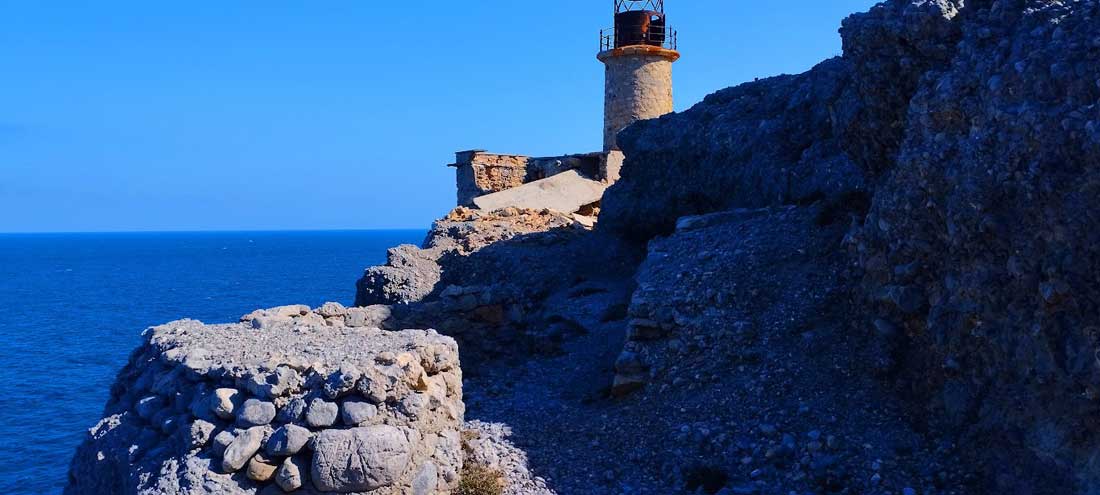
The lighthouse of Aforesmenos
The lighthouse of Aforesmenos is located 27km north of Agios Nikolaos, 20km from Elounda, and near the village of Vroucha. It was built on the cape of…
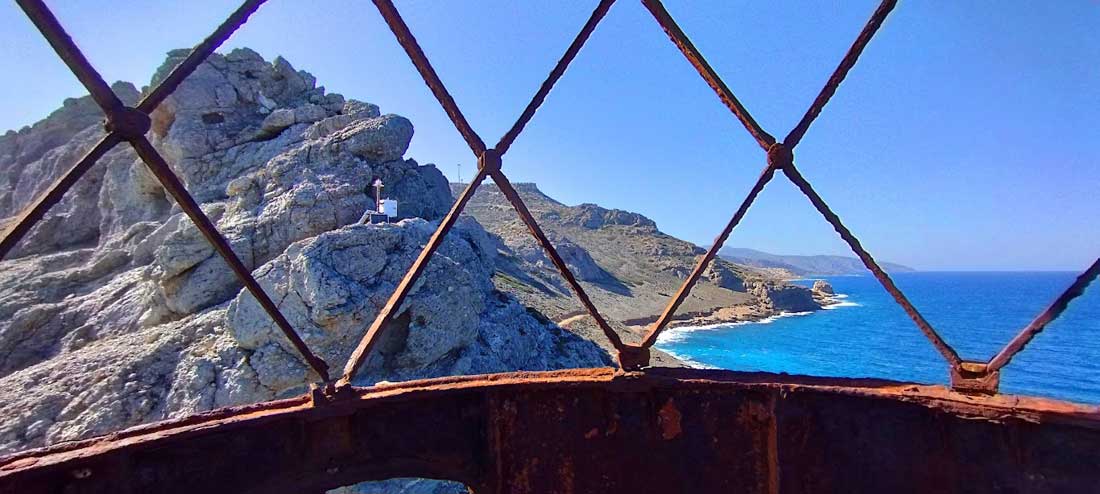
Vrouchas-Aforesmenos Lighthouse
From the village of Vrouchas we drive downhill on a narrow cement road at the beginning between cultivated fields, enjoying the impressive view of the sea. As…
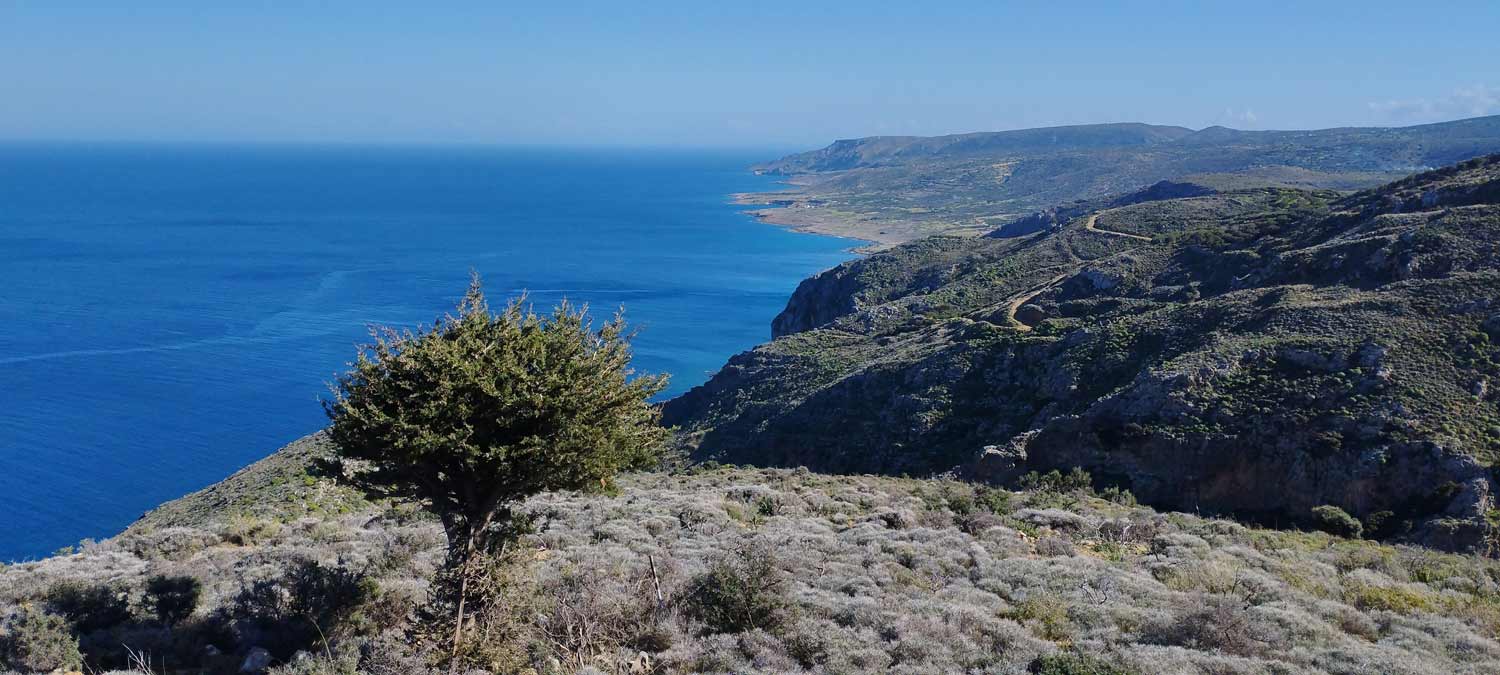
Skotini Gorge, Finokalia
A relatively small but impressive gorge with many changes in its landscape is the unknown gorge of Skoteini in the area of the settlement of Finokalia, Epano…
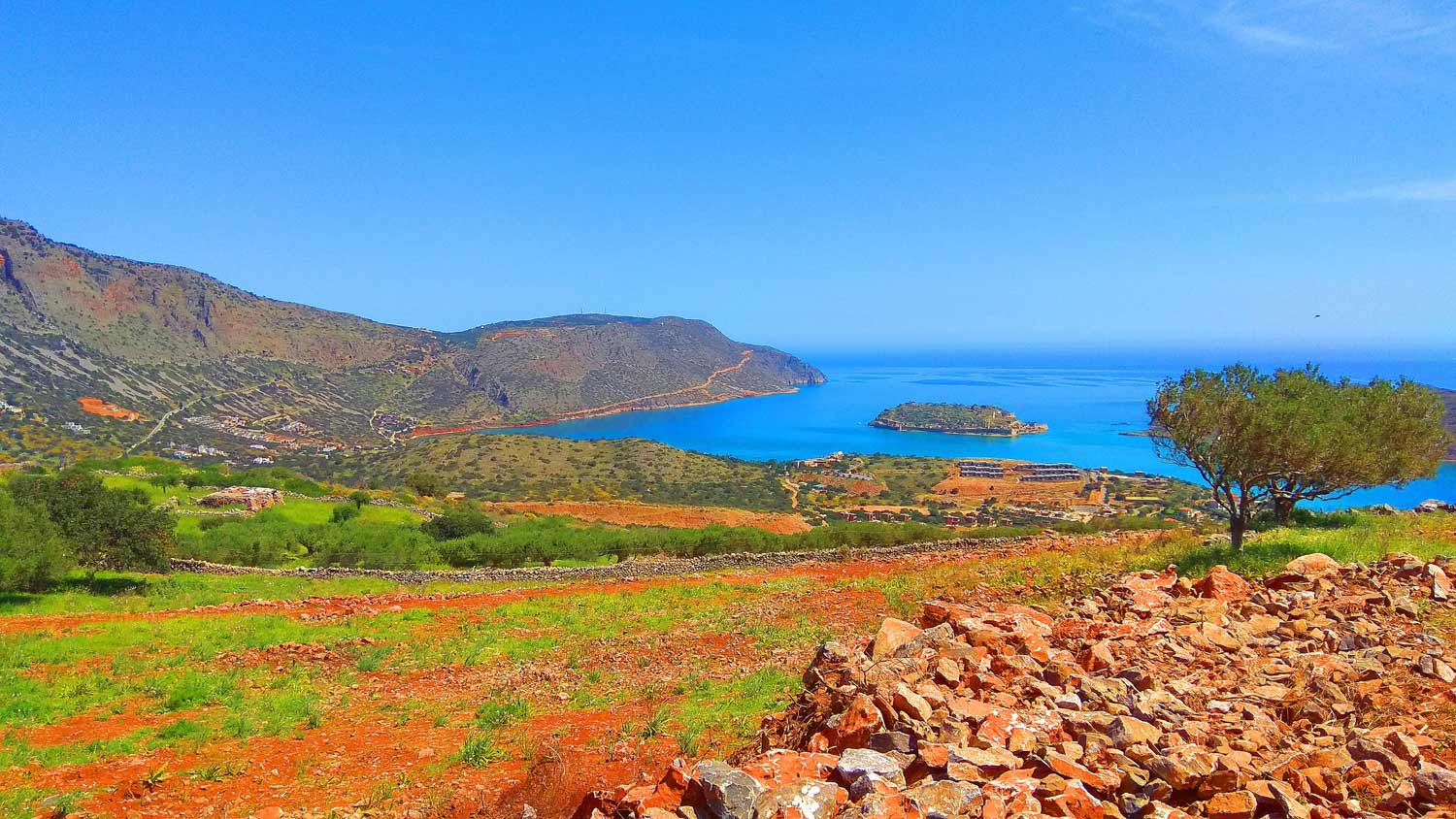
Havgas Gorge, Elounda
We start from Elounda village by car and head west towards the village of Pines. An excellent route through picturesque small settlements, the narrow asphalt takes us…
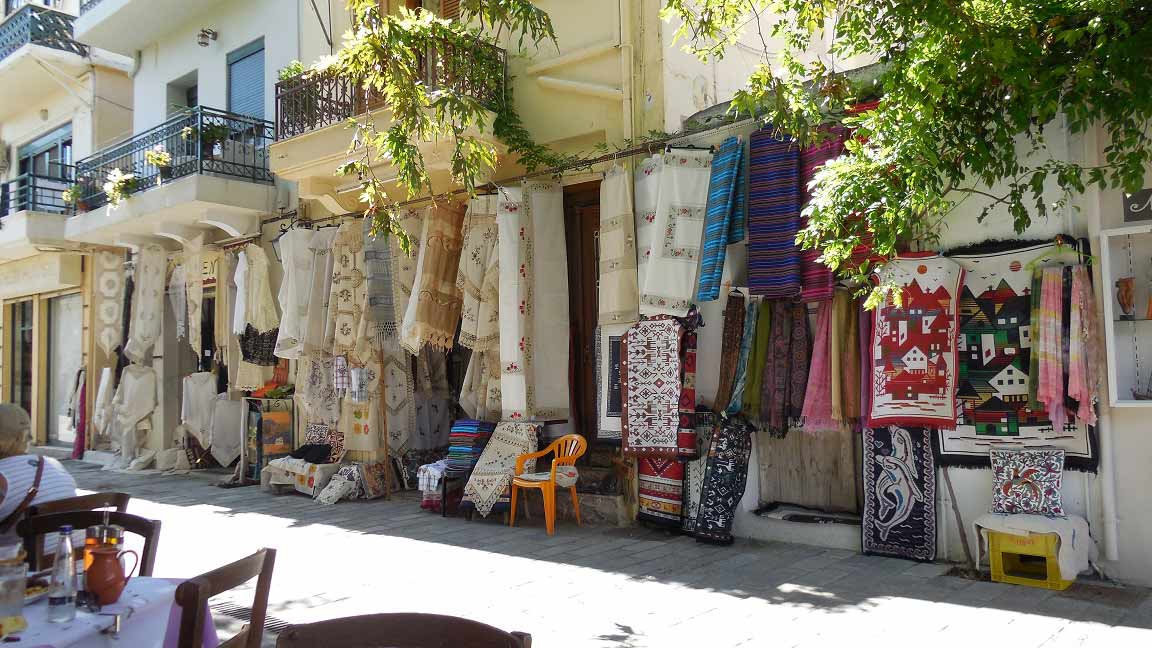
Kritsa
Kritsa is one of the oldest and most picturesque villages in Crete, Greece, built amphitheatrically on a rock hill, named Kastellos, surrounded by olive groves, at an…
Related Articles


This Post Has 0 Comments